

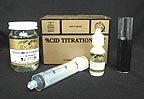
Acid Titration
Kit Contains
One plastic Syringe
Glass Test Vial
Bottle of Sodium Hydroxide
Bottle of Phenolphthalein Coloring Solution
Desirable Acid Levels
Fruit Wines .60% (6 cc's or ml's)
Red Fresh Grape Wines .65% (or 6.5 cc's or ml's)
White Fresh Grape Wines .75% (or 7.5 cc's or ml's)
How To Measure
Using an Acid testing kit with sodium hydroxide of .2 normal (1/5 normal):
* Titrate the must before fermentation begins. Carbon dioxide created during fermenation will produce inaccurate results.
1) Using the plastic syringe, measure 15 cc's or 15 ml's of must/juice and squirt into glass test vial . If the sample is of a red wine of a dark color, adding any amount of distilled water will lighten the color of the sample and allow for a more accurate reading of the test results.
2) Add 3-5 drops of Phenolphthalein color solution to the glass test vial sample
3) Wash out the syringe and draw in 10 cc's or ml's of sodium hydroxide. Add one cc of the sodium hydroxide to the glass test vial. Agitate the sample in the test vial by swirling it. Continue adding the sodium hydroxide in one cc incredments and swirling the sample until a deep dark color change is noted and an additional cc of sodium hydroxide does not make the sample any darker after agitation. This indicates that the acid in the test jar has been neutralized. White wines will turn a dark pink and red wines will turn a dark black/grey/blue.
4) Each 1 cc of sodium hydroxide required to attain the dark color change is equal to .1% of acid (expressed as tartaric). If your sample requires 6 cc's or ml's of sodium hydroxide to achieve the deep dark color change, your reading is .60%. This would be a good starting acid level for a fruit wine. If you are making a white wine from fresh grapes, it would indicate that acid should be added to the must as the amount of natural acid is a bit low.
5) Adjust the acid contend of the wine to the desired level based on the notes above and the type of wine you are making. Almost all fruit (berry or tree fruit) wines will require acid additions. For fruit wines, acid blend can be used to increase the acid level. For fresh grape wines, tartaric acid should be used to increase the acid level.
6) Make certain to keep the lids on the solutions tight as exposure to air will deteriorate the solutions and your readings will not be as accurate. Wash and dry syringe and test vial after each use.
Adjusting Acid Content
For fruit wines, use Acid Blend
For fresh Grape wines, use Tartaric Acid
To Increase the acid content of a must:
1/3 oz (9.5 grams) of acid added to one gallon of must raises acidity by .30%
1 oz acid to 6 gallons of must raises acidity by .15%
4 oz acid to 36 gallons must raises acidity by .10%
Example: If you have 5 gallons of red zinfandel grape must (19 liters) and you titrate your sample to .40% and you want the starting acid level to be .65%, do the following math:
.65-.40= .25



